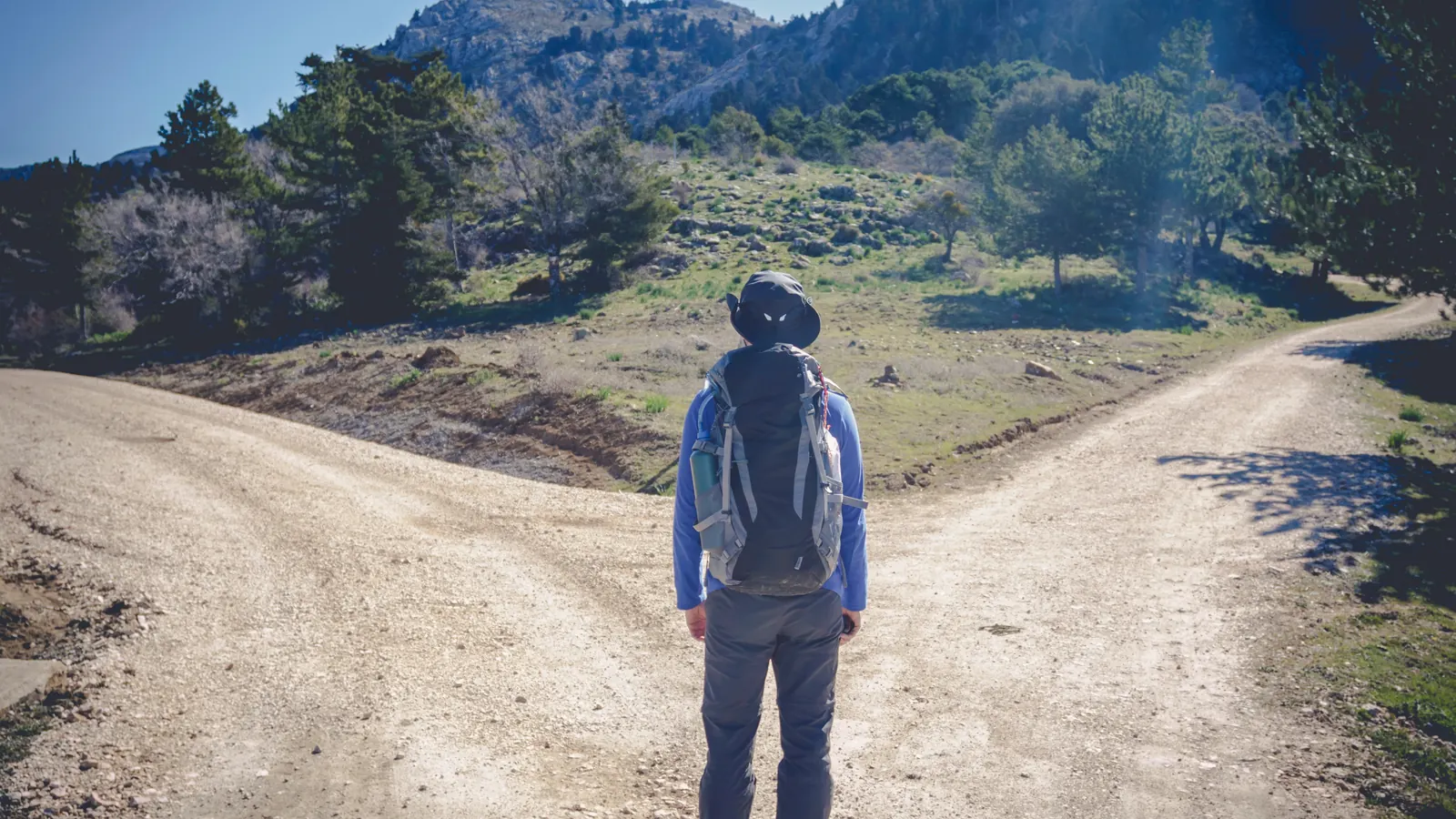
All through Scripture, God takes people into the wilderness to strip away distractions, show them what's in their hearts and speak to them in ways they couldn't hear before. Moses, Elijah, John the Baptist, Paul and Jesus himself were all shaped there. God says through the prophet Hosea, "I will lead her into the wilderness and speak tenderly to her" (Hosea 2:14, NIV). The wilderness isn't holy in itself. It's a place where tired people finally get quiet enough to listen.
We've been taking students and church leaders into the Colorado backcountry since 1997. This post explains why. It covers what Scripture teaches about the wilderness, what research is learning about time outdoors, and how to go in a way that leads to lasting change, not just a nice trip.
What Does "Wilderness" Mean in the Bible?
In Scripture, the wilderness is an empty, often harsh place outside the comfort and control of ordinary life. God uses it to test, humble, provide for and speak to his people. It's where self-reliance runs out and dependence on God begins.
The Hebrew word most often translated "wilderness" is midbar. It describes dry, open land used for grazing, far from cities. It is spelled with the same three Hebrew consonants as dabar, "to speak" or "word." Scholars debate whether the two words are actually related, but many Bible teachers have pointed out the echo, and Scripture's stories bear it out: the place with nothing in it is often where God's voice is heard most clearly.
Key terms to know
- Wilderness (midbar): Open, uncultivated land outside the city. In Scripture, a place of testing and of meeting God.
- Solitary place: The kind of setting Jesus went to for prayer (Mark 1:35). It means removed from crowds, not necessarily remote.
- Retreat: A deliberate step back from normal life for spiritual renewal.
- Wilderness-based spiritual formation: Discipleship that uses time outdoors, physical challenge and community to help people grow in faith.
Who Did God Meet in the Wilderness?
Many of the central figures in Scripture were formed in the wilderness before or during their ministry. The pattern is hard to miss.
Israel: forty years of learning dependence (Deuteronomy 8:2–3)
Moses told the people, "Remember how the LORD your God led you all the way in the wilderness these forty years, to humble and test you in order to know what was in your heart" (Deuteronomy 8:2). God fed them with manna "to teach you that man does not live on bread alone but on every word that comes from the mouth of the LORD" (8:3).
The wilderness revealed what was really in Israel's heart. It still does that. When comfort, routine and screens are gone, what's left in us comes to the surface.
Moses: forty years before the burning bush (Exodus 3:1–4)
Before Moses led anyone, he spent forty years tending sheep in Midian. God met him while he led the flock "to the far side of the wilderness" (Exodus 3:1). The burning bush didn't appear in Pharaoh's palace. It appeared where Moses had finally become ordinary.
Elijah: restored on the mountain (1 Kings 19)
When Elijah collapsed in exhaustion, God fed him in the wilderness, led him to Mount Horeb and spoke in "a gentle whisper" (1 Kings 19:12). We wrote a full post on Elijah's story and what it teaches burned-out leaders about rest.
John the Baptist: called in the desert (Luke 1:80; 3:2)
John "lived in the wilderness until he appeared publicly to Israel" (Luke 1:80). When his ministry began, Luke says "the word of God came to John son of Zechariah in the wilderness" (Luke 3:2). Not in the temple, not in Jerusalem. In the wilderness.
Jesus: led by the Spirit (Matthew 4:1–11; Mark 1:35; Luke 5:16)
Right after his baptism, Jesus "was led by the Spirit into the wilderness" (Matthew 4:1). Throughout his ministry, he kept going back to quiet places. "Very early in the morning, while it was still dark, Jesus got up, left the house and went off to a solitary place, where he prayed" (Mark 1:35).
Paul: three years in Arabia (Galatians 1:15–18)
After his conversion, Paul didn't immediately go to Jerusalem to meet the apostles. He went into Arabia (Galatians 1:17) and returned to Damascus, and three years passed before he went up to Jerusalem. Scripture doesn't tell us everything that happened there, but Paul clearly treated that season as formative.
What Does Research Say About Time in Nature?
Research doesn't prove anything about God, but it lines up with what Scripture's pattern suggests: getting away from cities and screens changes how people think and feel.
- In a 2015 Stanford study, participants randomly assigned to a 50-minute walk in a natural setting showed less anxiety, less rumination and less negative emotion than those who walked in an urban setting.
- A related Stanford study found that a 90-minute walk in nature reduced self-reported rumination and activity in a brain region linked to it. Rumination is the repetitive negative thinking tied to depression and anxiety.
- University of Utah and University of Kansas researchers studied adults on Outward Bound backpacking trips and found that four days of immersion in nature, disconnected from devices, raised performance on a creative problem-solving task by 50%.
For a minister stuck in repetitive worry, or a student whose mind never gets a break from a phone, that matters. The quiet the prophets found has a measurable effect on the mind God made.
How to Go Into the Wilderness With Purpose: Five Steps
A wilderness trip helps people grow spiritually when it's planned around meeting God, not just around the hike. These five steps reflect what Scripture models and what we've learned leading trips for nearly three decades.
Step 1: Go to find out what's in your heart
God's purpose for Israel in the wilderness was "to know what was in your heart" (Deuteronomy 8:2). Go with that question.
- Before the trip, write down one honest answer to: "What am I carrying that I haven't dealt with?"
- Ask God to show you what the noise of normal life has been covering up.
Step 2: Unplug on purpose
In the Utah study, participants were disconnected from devices the whole time, and the researchers believe that was part of the effect. Phones keep the city in your pocket.
- Turn off your phone, or leave it behind if safety plans allow. Give your family an emergency contact instead.
- For students, frame it as a gift of attention, not a punishment.
Step 3: Let your body do the work
Elijah walked forty days to Horeb (1 Kings 19:8). Physical effort quiets the mind in a way sitting in a conference session can't.
- Choose a challenge that matches your group's ability, then let it stretch you.
- Notice how exhaustion strips away pretense. People talk honestly on mile six who wouldn't on mile one.
Step 4: Practice silence and Scripture
Creation preaches its own sermon. "I lift up my eyes to the mountains—where does my help come from? My help comes from the LORD, the Maker of heaven and earth" (Psalm 121:1–2).
- Build in at least one stretch of silence every day, even 20 minutes alone with a Bible and a journal.
- Read passages written in or about the wilderness: Psalm 121, Psalm 23, Isaiah 40, 1 Kings 19.
Each week, our campers are prayed out into the wilderness, away from camp, for three hours of solo time. They carry their Bibles, journals, water, a whistle and a few essentials into a place God has prepared for them. Each camper goes just far enough from camp that they can't see the others, and the whistle brings staff quickly if they need help.
One day, about 90 minutes after they set out, a young man walked back into camp and sat down with our staff in the meadow. "I don't think I've ever spent more than five minutes in silence, much less that long," he said. "But when I sat down by the creek, I dropped my Bible and it kind of fell open. I looked down, and right there were the words 'Be still, and know that I am God.' I mean, we sing that song all the time, but I didn't really know it was Scripture. And there it was. So I've just been sitting there singing, for I don't know how long. I kind of lost track of time."
We all had a moment of awe. So we sat there together, and then we sang.
The verse he found is Psalm 46:10. A teenager who had never been quiet for five minutes heard it on a creek bank, because for once nothing else was talking.
Step 5: Leave something behind and bring something home
On every TEAM Ascend summit, each person leaves a rock behind. The rock is never named out loud. It represents whatever separates that person from God or stands in the way of their faith. Leaving it on the summit is an act of letting go, so they can go home ready to be filled with his blessings.
Scripture also tells God's people to bring something home. After crossing the Jordan, Israel set up twelve stones so that "in the future, when your children ask you, 'What do these stones mean?'" they could tell the story of God's faithfulness (Joshua 4:6–7).
- Decide what you're leaving on the mountain.
- Decide what reminder of God's faithfulness you'll carry back, and who you'll tell.
What the Wilderness Takes Away and What It Gives
The value of the wilderness is in what it removes as much as in what it adds. This summary connects the two with the Scripture behind them.
| What the wilderness removes | What it gives instead | Scripture |
|---|---|---|
| Constant noise and screens | Room to hear God's quiet voice | 1 Kings 19:12 |
| Control and comfort | Daily dependence on God's provision | Deuteronomy 8:3 |
| Titles and roles | Being seen as a person, not a position | Exodus 3:1 |
| Busyness | Unhurried prayer | Mark 1:35 |
| Isolation in a crowd | Real companionship on the trail | Ecclesiastes 4:9–10 |
| Self-reliance | Strength renewed by God | Isaiah 40:31 |
Frequently Asked Questions About the Wilderness and Spiritual Renewal
Why did God use the wilderness so often in the Bible?
Because it removes the things people lean on instead of God: comfort, control, crowds and status. In the wilderness, Israel learned to depend on manna, Moses met God at the burning bush, and Elijah heard the gentle whisper. It's a place of testing, but also of tenderness (Hosea 2:14).
Do I have to go to the mountains to meet God?
No. God is present everywhere (Psalm 139:7–10), and you can meet him in your office or living room. But Scripture shows that places and rhythms matter. Jesus could have prayed anywhere, yet he often chose solitary places. Stepping out of your normal setting makes it easier to notice God who was there all along.
Are wilderness trips safe for youth groups?
They can be, when they're led by trained, experienced staff with clear safety plans, medical information, emergency procedures and appropriate group sizes. Never take students into the backcountry without that preparation. Ask any wilderness ministry about their safety training, child-protection policies and emergency plans before your group commits to a trip.
How long does a wilderness trip need to be?
Even a 90-minute walk outdoors has measurable benefits. For deeper spiritual renewal, several days work best. Research on backpacking trips found a sharp jump in creative problem-solving after about four days unplugged, and many leaders tell us the real conversations start around day three.
What should leaders do after they come home?
Plan for re-entry before you leave. Schedule a lighter first week back. Share what God did with your spouse, staff or small group. Keep one practice from the trip going at home, such as a weekly walk, a silent morning or a set time in Scripture. The point isn't to recreate the mountain. It's to remember what you heard there.
Can burned-out ministers benefit even if they aren't outdoorsy?
Yes. You don't need experience, gear or great fitness to start. Good wilderness ministries choose routes that fit the group and provide what you need. Many of the leaders who are most changed are the ones who were least sure they belonged on a trail.
A Final Word From the Trail
God said he would lead his people into the wilderness and speak tenderly to them. For nearly thirty years we've watched him keep that promise with students, youth ministers and church leaders. Many came up the mountain tired and came down having heard from God again.
If you need that, or your students do, TEAM Ascend leads wilderness-based spiritual formation trips in the Colorado mountains. Come leave a rock on the summit. Bring home something better.
Sources
- Bratman et al. (2015): The benefits of nature experience, improved affect and cognition
- Greater Good Science Center: How nature makes you kinder, happier, more creative
- Atchley, Strayer & Atchley (2012): Creativity in the wild, PLoS ONE
Scripture quotations taken from The Holy Bible, New International Version® NIV®. Copyright © 1973, 1978, 1984, 2011 by Biblica, Inc.™ Used by permission. All rights reserved worldwide.